

To remember sermons better, use these science-backed techniques: take structured notes during the service, review them within 24 hours using spaced repetition, discuss key points with others, and apply one takeaway to your life each week. Research shows that active engagement, not passive listening, is what makes sermons stick.
You listen intently during Sunday service. The pastor's words move you. You even take a few notes. But by Monday morning, it's already fading. By Wednesday, you can barely remember what the sermon was even about. By the following Sunday, it's completely gone.
If this sounds familiar, you're not alone, and it's not a reflection on your spiritual engagement or memory. It's actually how your brain is designed to work. Understanding why you forget sermons is the first step to actually remembering them.
Why We Forget Sermons
In 1885, a German psychologist named Hermann Ebbinghaus conducted a famous study on memory. He spent months memorizing lists of meaningless syllables and testing how quickly he forgot them. The result became known as the "forgetting curve," and it's as relevant to sermons today as it was to Ebbinghaus's syllables.
Here's what the research shows: You forget about 50% of what you hear within the first hour. After 24 hours, you're down to about 30% retention. By a week later, if you haven't reinforced the information, you've forgotten roughly 70% of it.
Sermons are particularly vulnerable to this forgetting curve because they're passive listening. You're sitting in a pew (or on a couch, if you're online), receiving information. Your brain isn't actively processing and encoding it the way it would if you were reading, writing, or having a conversation. This is biology, not a personal failing. Your brain is simply doing what brains naturally do with passively received information: letting it go.
The good news? The forgetting curve isn't destiny. Ebbinghaus also discovered that if you actively revisit information at strategic moments, you can dramatically slow the decay. You can move sermons from your short-term memory into lasting retention.
Listen With Intent
The first step to remembering a sermon is to listen differently. Most people show up and passively receive the message, so come prepared with a question instead. Before the service, ask yourself what God wants to say to you today, or make it more specific: how should I respond to conflict this week, what am I struggling with that I need guidance on, where do I need encouragement. Having a question in mind changes how your brain processes the next forty minutes. You're hunting for meaning rather than waiting for it to land on you.
Two practical habits support this:
- Sit closer to the front. It reduces distractions and signals your brain that you're engaged. You'll naturally pay closer attention.
- Put your phone on Do Not Disturb. Not just silent. Put it actually out of reach. Even the presence of your phone divides your attention. You can't listen with intent when half your brain is wondering if you have a notification.
This alone won't cement the sermon in long-term memory, but it ensures you're actually receiving the message in the first place. If staying alert is the real struggle, we wrote a whole guide on how to pay attention in church.
Take Notes, But Not Too Many
Note-taking during a sermon is powerful, but only if you do it right, and the temptation is always to transcribe. That defeats the purpose: when you're busy writing word-for-word you stop listening, and you become a transcription service rather than a participant. Write key phrases instead. When the pastor makes an important point, jot down three to five words that capture the idea, skip the connecting words, and abbreviate everything you can.
The real gain comes from paraphrasing, translating what the pastor said into your own language. Don't write what he said, write what it means to you. Having to render an idea in your own words forces deeper processing, and your brain encodes it more strongly as a result: you're not copying, you're understanding. Research on note-taking shows that the act of writing improves memory regardless of what you write, but paraphrasing beats transcription every time. Write less, and make it yours.
For more detailed guidance on note-taking methods, check out our article on how to take sermon notes. Different approaches work for different people: the outline method, the Cornell method, the timestamp method, and more.
Review Within 24 Hours
This is the critical window, and it's where most people drop the ball. The forgetting curve tells us decay happens fastest in the first 24 hours, but it also tells us something more hopeful: review the information inside that window and you reset the curve dramatically. So spend five to ten minutes on your notes the same day you heard the sermon, ideally that afternoon or evening, though Monday morning still counts for a great deal. The process is three steps:
- Read through your notes without looking anything up.
- Close your notes and try to restate the main points from memory.
- Open your notes again and see what you remembered correctly and what you forgot.
That retrieval practice, trying to recall before checking, is what locks information into long-term memory. You're not passively reviewing, you're testing yourself, and the difference is large. Retrieval practice is one of the most reliable findings in learning research. A five-to-ten-minute session is the difference between forgetting a sermon by Wednesday and still holding it a month later.


Discuss With Someone
Teaching is the best form of learning. Explaining something to another person forces you to organize your thoughts, fill in the gaps you didn't know were there, and answer questions you hadn't considered, and all of that deepens understanding and cements memory. So talk about the sermon after church, and actually discuss it rather than mentioning it in passing. What did it mean? How does it apply to your week? What did someone in your small group make of a particular point? For turning that conversation into action, see our guide on how to apply a sermon to your life.
The venue doesn't matter as much as the act of articulation:
- Family lunch. Talk through the sermon as you eat. Ask your kids what stuck with them. Share what God spoke to you.
- Small group or Bible study. If your church has a group that meets midweek, bring up the sermon. Use it as a springboard for discussion.
- A friend or accountability partner. Even a quick text to a friend: "Hey, the sermon today hit me because..." You're not writing a thesis, just articulating one takeaway.
Social engagement with the material activates different parts of your brain than individual study. You remember what you discuss because you engaged with it socially, emotionally, and intellectually.
Use Spaced Repetition
Reviewing once in the first 24 hours resets the forgetting curve, but it will decay again, just more slowly, so keeping a sermon in long-term storage takes strategic reinforcement. That's what spaced repetition is: review the material again before you've completely forgotten it, and the memory comes back stronger and lasts longer each time. A practical schedule looks like this:
- Sunday: Hear the sermon. Review notes in the evening (5-10 minutes).
- Wednesday: Spend 2-3 minutes reviewing those notes again. Maybe discuss with someone from your group.
- Next Sunday: Skim the notes before the next service starts.
Three touchpoints across a week sounds like a lot until you notice how brief each one is. Every review strengthens the neural pathways tied to that sermon, and by the third the information has moved out of short-term working memory into durable storage. This is why the forgetting curve, sobering as it is, ends up being hopeful. You don't have to fight your memory forever. A few well-timed reinforcements and the sermon becomes a lasting part of how you think and live. The same schedule works for individual verses, as we show in how to memorize Scripture.
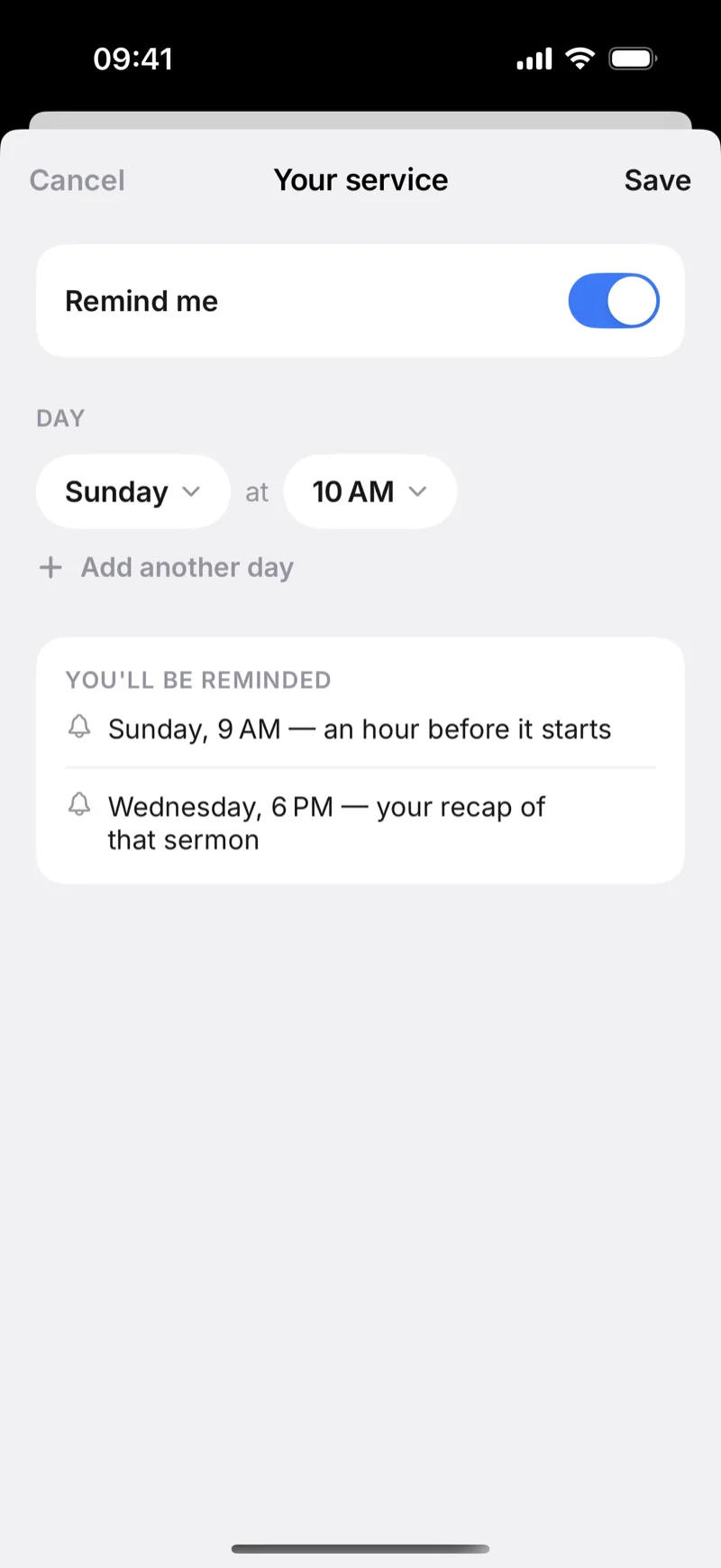
Sermon Keeper can take the Wednesday step off your plate: when you tell it when your service is, it reminds you an hour before it starts and sends a recap of that sermon three days later.
Record and Revisit
If your church records sermons, and most do, use that recording as a resource. You don't need to relisten to the whole thing: use your notes as a map instead. If something strikes you during the service, jot down the approximate time, then later in the week jump straight to that moment and replay a few minutes. Hearing the pastor's tone, emphasis and exact words again reignites the insight and fixes it more firmly than reading a note about it ever will.
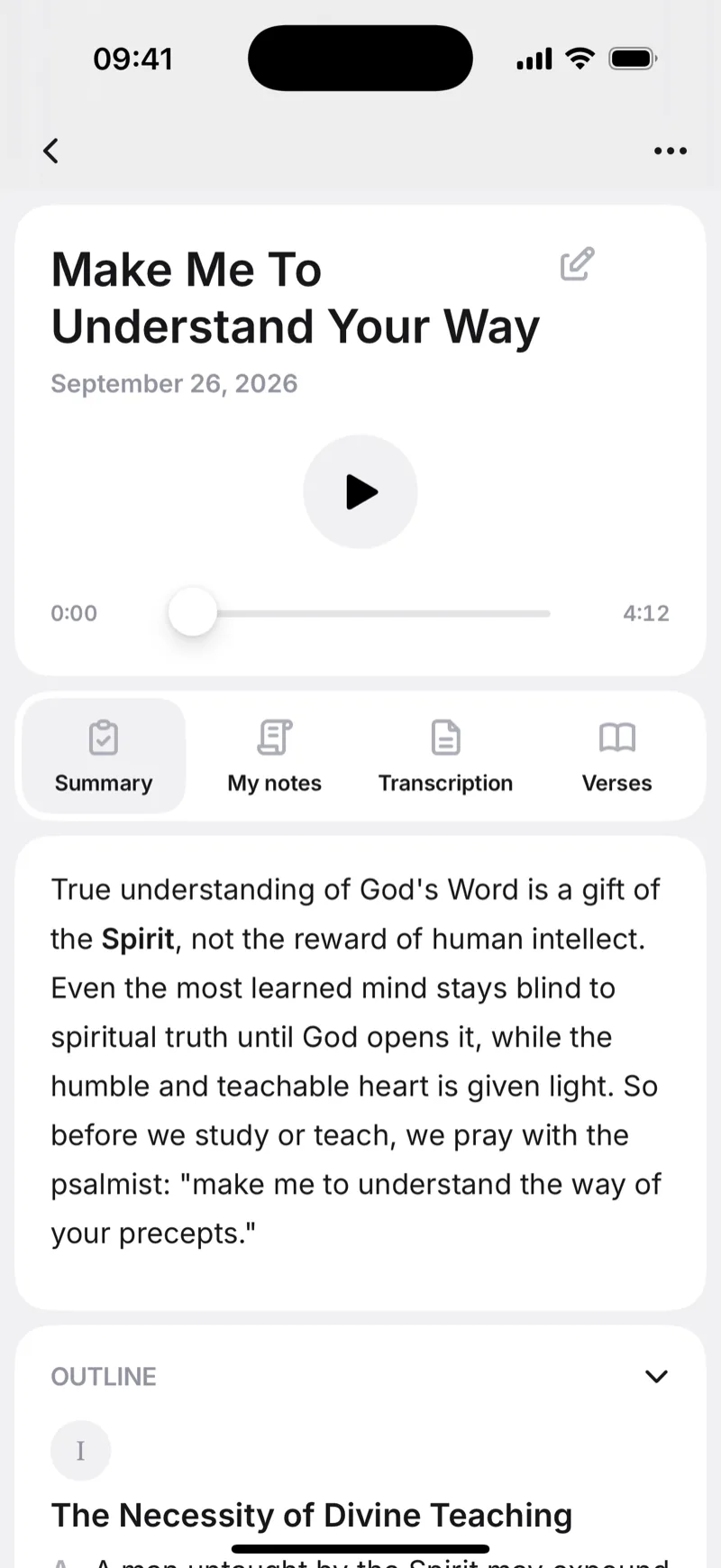
Even better: many churches now provide sermon transcripts or AI summaries. A two-minute skim of a transcript or summary hits different from rewatching 40 minutes of video. You get the key points, the structure, and the main ideas without the time investment.
Timestamp notes are particularly powerful here. If your sermon notes app lets you mark specific moments with a brief note, a line like "forgiveness story, 12:34" takes you straight to minute 12:34 instead of hunting through 40 minutes of audio. AI transcription makes it easier still: with a full text transcript you search for your keywords and jump to the section that matters. Either way you've bridged the gap between passive listening on Sunday and active engagement with the ideas afterward.
Putting It All Together
You don't have to do all of these things. But each one you add increases retention exponentially. Here's what a realistic week might look like:
- Sunday morning: Go in with a question. Sit closer to the front. Take brief notes in your own words (5 minutes of effort during service).
- Sunday evening: Spend 5 minutes reviewing your notes, recalling from memory first, then checking what you remembered (5 minutes).
- Wednesday: Skim your notes again while grabbing coffee. Maybe mention one idea to a friend (2 minutes).
- Next Sunday: Glance at last week's notes before the next service (1 minute).
That's roughly 13 minutes across an entire week, and research on spaced review suggests that even that modest an investment makes a real difference to how much stays with you. The forgetting curve isn't something to fight, it's something to work with. You don't have to remember everything; you only have to reinforce the moments that mattered. A sermon that moves you on Sunday doesn't have to be gone by Tuesday, and the techniques above are grounded in how memory actually works rather than in trying harder.
Frequently Asked Questions
It's not a personal failing. It's how the brain works. According to the Ebbinghaus forgetting curve, we lose about 50% of passively received information within an hour and up to 70% within a week. Sermons are especially vulnerable because they involve passive listening. Without active reinforcement like note-taking or review, the memory simply fades.
Yes, but how you take notes matters more than how much you write. Research shows that paraphrasing in your own words is far more effective than transcribing word-for-word. Jot down key phrases, translate ideas into your own language, and focus on meaning rather than capturing every sentence. The act of writing itself improves encoding, and paraphrasing deepens it further.
Just 5 to 10 minutes on the same day you heard the sermon does more for your memory of it than anything else you can do. A brief 2- to 3-minute review midweek and a quick skim before the next Sunday service adds up to about 13 minutes total for the week, a small investment for a dramatic improvement in how much you remember.
Spaced repetition is a learning technique where you review information at gradually increasing intervals before you forget it. For sermons, a practical schedule is: review your notes Sunday evening, revisit them briefly on Wednesday, and skim them again the following Sunday. Each review strengthens the neural pathways, moving the sermon from short-term memory into durable long-term retention.
You can improve retention without writing anything down, but it takes more deliberate effort. Listening with a specific question in mind, discussing the sermon with someone afterward, and mentally recalling the main points later that day all help. That said, combining even minimal notes with one or two review sessions gives the strongest results.