

Here are two free printable Bible reading plans for 2027. The first takes you through the whole Bible in a year, about 10 to 15 minutes a day. The second takes you through the New Testament one chapter each weekday, about five minutes. Both are dated PDFs with a checkbox for every day. Below you'll find how to pick one, how to keep going past January, and what to do when you miss a few days.

Take notes on what you read
Scan your Bible page in Sermon Keeper and get a SOAP study card for any verse. Free 3-day trial.
Download the free 2027 Bible reading plans (PDF)
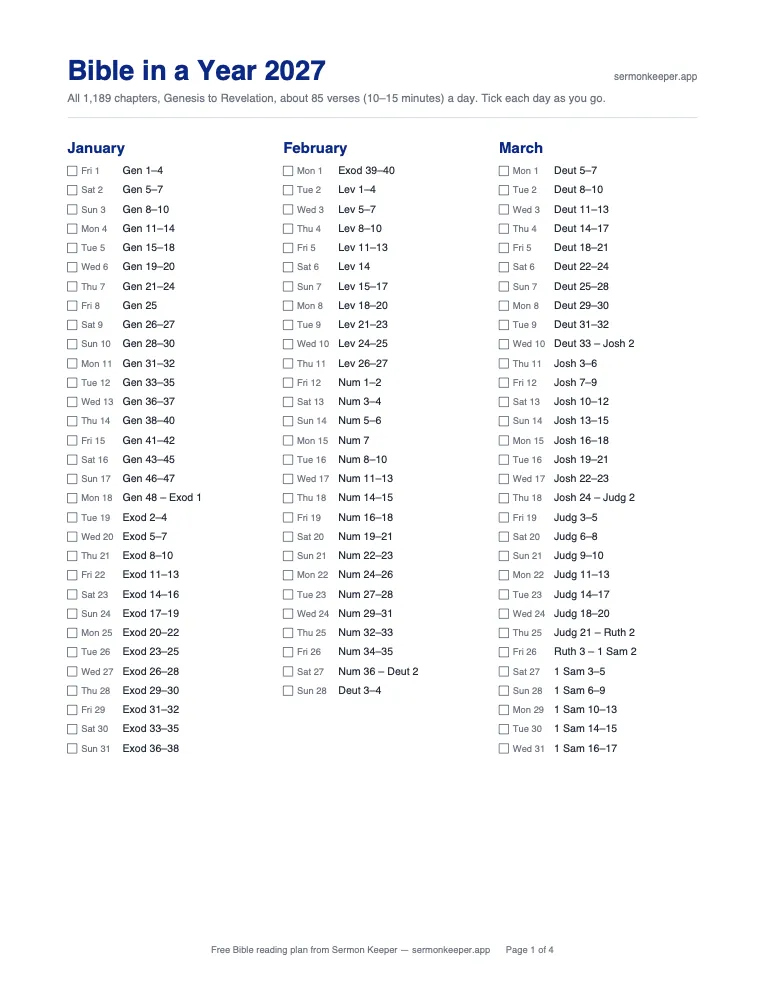
Bible in a Year 2027
All 1,189 chapters, Genesis to Revelation, in 365 days. About 85 verses a day, January 1 to December 31. Four pages, three months per page.
Download the whole-Bible plan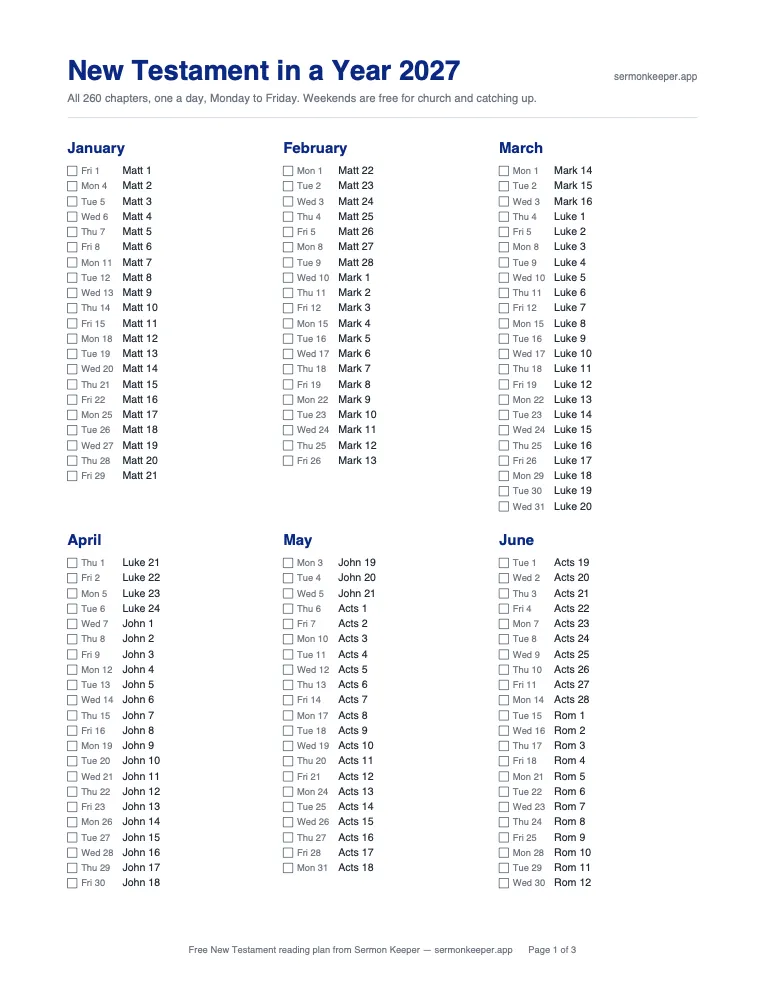
New Testament in a Year 2027
All 260 chapters, one each weekday, Matthew 1 on January 1 to Revelation 22 on December 30. Weekends stay free. Three pages, with a notes page.
Download the New Testament planBoth are US Letter and print on A4 with "Fit to page". No email or sign-up needed.
Which Bible reading plan should you choose?
- The New Testament plan is the best first plan. A chapter takes about five minutes, you meet Jesus in the Gospels in the first months, and the weekends give you room to catch up. If you've tried a Bible-in-a-year plan before and stopped in Leviticus, start here.
- The whole-Bible plan is for when you're ready for 10 to 15 minutes a day. It reads the books in the order of your Bible, from Genesis to Revelation. Instead of a fixed number of chapters, each day has a similar amount of text: some days are four short chapters, and Psalm 119, the longest chapter in the Bible, gets a day to itself.
- A chronological plan puts the Bible in the order events happened, for example reading Job near Genesis and the Psalms alongside David's life. Many people love it, but scholars disagree on parts of the order, so we haven't made one we can't check. If you want one, ask your church which plan it uses, so you can read along with others.
If your church is reading through a book together this year, the best plan is the one they're using. Reading alongside other people makes it much easier to keep going.
What January looks like
Here are the first two weeks of the whole-Bible plan. Genesis takes until January 18, and Exodus starts the same day.
| Date | Reading | Date | Reading |
|---|---|---|---|
| Fri, Jan 1 | Genesis 1–4 | Fri, Jan 8 | Genesis 25 |
| Sat, Jan 2 | Genesis 5–7 | Sat, Jan 9 | Genesis 26–27 |
| Sun, Jan 3 | Genesis 8–10 | Sun, Jan 10 | Genesis 28–30 |
| Mon, Jan 4 | Genesis 11–14 | Mon, Jan 11 | Genesis 31–32 |
| Tue, Jan 5 | Genesis 15–18 | Tue, Jan 12 | Genesis 33–35 |
| Wed, Jan 6 | Genesis 19–20 | Wed, Jan 13 | Genesis 36–37 |
| Thu, Jan 7 | Genesis 21–24 | Thu, Jan 14 | Genesis 38–40 |
The PDFs use short book names to fit a whole year on four pages (Gen for Genesis, Exod for Exodus, Ps for Psalms). If an abbreviation is new to you, our guide on how to read Bible references has the full list.
How to stick with a Bible reading plan in January
Starting on January 1 is easy. Keeping going once the new-year energy fades is the hard part. A few simple habits help:
- Same time, same place. Attach the reading to something you already do every day: the first coffee, the train, lunch. "When I sit down with coffee, I open my Bible" works better than "I'll read sometime today."
- Keep the PDF where you'll see it. Tape it inside your Bible or next to the coffee machine. A row of ticked boxes is a small daily win, and it's easier to keep a streak going when you can see it.
- Read with someone. Pick the same plan as a friend, your spouse or your small group, and send each other one verse a day. You'll keep going for them on the days you wouldn't for yourself.
- Let Sunday help. Listen for connections between the sermon and what you read during the week, and bring a question from your reading to church.
- Aim for understanding, not speed. If a chapter grips you, stop and think about it. The plan is a guide, not a race.
If you'd like the Bible's own picture of a daily habit, Psalm 1 describes the person whose "delight is in the law of the Lord; and in his law doth he meditate day and night" (Psalm 1:2, KJV).
What to do when you fall behind
You will miss days. Everyone does. What matters is what you do next:
- Skip to today's date. Read today's reading, tick it, and keep going. Don't try to read five days in one sitting.
- Catch up at the weekend, or let it go. On the New Testament plan the weekends are already free. On the whole-Bible plan, use a quiet Saturday to read one or two missed days. If you can't, leave the boxes empty and finish them in December, or next year.
- Don't restart from January 1. Starting over means you're always behind, and that's discouraging. A plan with gaps that you finish is better than a perfect plan you abandon.
- Switch plans if you need to. If the whole-Bible plan is too much this season, move to the New Testament plan at today's date. That's not failing. It's choosing a pace you can keep.
How to take notes on what you read
Reading is good. Reading and writing one or two lines is better, because writing makes you slow down and remember. You don't need a long journal entry. Try this after each reading:
- One verse that stood out, copied out in full with the reference.
- One sentence about what it shows you about God, or about people.
- One step you'll take today because of it.
That's a short version of the SOAP Bible study method (Scripture, Observation, Application, Prayer), which has its own free template and a 30-day plan for January. For margins, highlighting and keeping notes in a notebook or on your phone, see how to take Bible notes, and if you'd like more writing ideas, Bible journaling for beginners has 40 prompts.
If you'd rather keep your notes on your phone, Sermon Keeper can help with that step. Take a photo of the page you just read, pick the verse, and you get a SOAP study card in about 30 seconds: the verse, an observation, an application, cross-references and a prayer, which you can then edit in your own words. On Sunday, the same app records the sermon while you tap short notes, and lists every verse the pastor named. Try it free for 3 days.
Many churches also start January with a season of prayer and fasting. If yours does, our guide to 21 days of prayer and fasting has a daily prayer list and a printable journal that fit alongside your reading plan, and our collection of New Year Bible verses has a verse for every week of January.
Frequently asked questions
About 10 to 15 minutes a day. The whole Bible has 1,189 chapters and about 31,100 verses, so a one-year plan comes to roughly 85 verses a day. Our plan splits the days by verse count, not by chapter, so each day is a similar amount of reading.
If you have never read through the Bible, start with the New Testament plan: one chapter each weekday, about five minutes. It begins with Matthew and ends with Revelation by December 30, and weekends stay free. Move to the whole-Bible plan the next year.
No. The plans have dates to make tracking easy, but you can start any day. Write your own start date at the top, or simply begin at today's date and read the days you missed when you have time.
Skip to today's reading and keep going. Catch up on missed days at the weekend if you want to, or let them go. Starting over from day one usually just puts you further behind.
Not yet. A chronological plan arranges the books and chapters in the order events happened, and scholars disagree on parts of that order. We would rather not publish one we can't check carefully. Our two plans follow the order of the books in your Bible.
Any translation you understand and enjoy reading. The plans list chapters, not text, so they work with every version. If you're choosing one, our guide to Bible versions compares the most common translations.
