

A Bible reference is an address: book, then chapter, then verse. In John 3:16, "John" is the book, 3 is the chapter, and 16 is the verse. Learn the handful of symbols that can follow it (a colon, a dash, a comma, a semicolon, and a couple of abbreviations) and you can read any reference in a sermon outline, a study guide or a footnote.
Most of us picked this up by osmosis and never had it explained. That's fine until the pastor says "turn to First John four" and you land in the Gospel of John, chapter one. This guide covers the whole system in one place, including the full list of book abbreviations, so you never have to guess again.
The basic pattern: book, chapter, verse
Every reference is built the same way. The name tells you which of the Bible's 66 books to open. The first number is the chapter. The number after the colon is the verse.
- John 3:16 — the book of John, chapter 3, verse 16.
- Genesis 1:1 — the first verse of the first chapter of Genesis.
- Psalm 23 — no colon, so it means the whole of Psalm 23.
- Romans 8 — the whole of Romans chapter 8.
Inside a printed Bible, the chapter numbers are the large ones that start each new section, and the verse numbers are the small raised numbers inside the text. Once you know which is which, you can find any reference in two moves: big number, then small number.
What each symbol means
The core pattern stretches to cover ranges, lists and partial verses. Here's every symbol you're likely to meet:
| Symbol | Example | What it means |
|---|---|---|
| Colon : | John 3:16 | Chapter 3, verse 16 |
| Dash – | Romans 8:28–30 | Verses 28 through 30 |
| Dash across chapters | Matthew 5:1–7:29 | From 5:1 all the way to 7:29 (the whole Sermon on the Mount) |
| Comma , | John 3:16, 18 | Verses 16 and 18, skipping 17 |
| Semicolon ; | John 3:16; 5:24 | Two separate passages: John 3:16 and John 5:24 |
| a / b | Matthew 5:3a | The first part (a) or second part (b) of the verse |
| ff | Romans 12:1ff | Verse 1 and the verses that follow |
| v. / vv. | vv. 4–7 | Verse / verses, in the chapter already named |
| cf. | cf. Luke 3:21 | "Compare": a related passage worth reading alongside |
| Period instead of colon | John 3.16 | The same as John 3:16, common in British and European writing |
The one that trips people up most is the difference between the dash and the comma. A dash is continuous: read everything in between. A comma is a list: read only the verses named.
Numbers in front of a book name
In 1 Corinthians 13:4–7, the 1 isn't a chapter. It's part of the book's name: Paul's first letter to the church in Corinth, read aloud as "First Corinthians." Several books come in pairs or threes:
- 1 and 2 Samuel, 1 and 2 Kings, 1 and 2 Chronicles
- 1 and 2 Corinthians, 1 and 2 Thessalonians, 1 and 2 Timothy
- 1 and 2 Peter, and 1, 2 and 3 John
Older Bibles, including the King James Version's own book titles, use Roman numerals instead: I Corinthians, II Kings, III John. It's the same book.
Watch for the classic mix-up: 1 John 4:8 ("God is love") is in the short letter near the end of the New Testament, while John 1:4 is in the Gospel of John. Same words, different order, completely different place in your Bible.
Books with only one chapter
Five books are a single chapter long: Obadiah, Philemon, 2 John, 3 John and Jude. Because there's no chapter to choose, references often give only the verse. Jude 3 means Jude, verse 3, and Philemon 6 means Philemon, verse 6. You'll also see them written in full, as Jude 1:3, which points to exactly the same verse.
Bible book abbreviations
Study Bibles, commentaries and sermon outlines shorten book names to save space. There's no single official list, but these are the forms you'll meet most often.
Old Testament
| Book | Common abbreviations |
|---|---|
| Genesis | Gen, Gn |
| Exodus | Ex, Exod |
| Leviticus | Lev, Lv |
| Numbers | Num, Nm |
| Deuteronomy | Deut, Dt |
| Joshua | Josh, Jos |
| Judges | Judg, Jdg |
| Ruth | Ruth, Ru |
| 1 & 2 Samuel | 1 Sam, 2 Sam |
| 1 & 2 Kings | 1 Kgs, 2 Kgs |
| 1 & 2 Chronicles | 1 Chr, 2 Chr |
| Ezra | Ezra, Ezr |
| Nehemiah | Neh |
| Esther | Esth, Est |
| Job | Job |
| Psalms | Ps, Psa, Pss |
| Proverbs | Prov, Prv |
| Ecclesiastes | Eccl, Eccles |
| Song of Solomon (Song of Songs) | Song, SS |
| Isaiah | Isa, Is |
| Jeremiah | Jer |
| Lamentations | Lam |
| Ezekiel | Ezek, Ez |
| Daniel | Dan, Dn |
| Hosea | Hos |
| Joel | Joel, Jl |
| Amos | Amos, Am |
| Obadiah | Obad, Ob |
| Jonah | Jonah, Jon |
| Micah | Mic |
| Nahum | Nah |
| Habakkuk | Hab |
| Zephaniah | Zeph |
| Haggai | Hag |
| Zechariah | Zech |
| Malachi | Mal |
New Testament
| Book | Common abbreviations |
|---|---|
| Matthew | Matt, Mt |
| Mark | Mark, Mk |
| Luke | Luke, Lk |
| John | John, Jn |
| Acts | Acts |
| Romans | Rom |
| 1 & 2 Corinthians | 1 Cor, 2 Cor |
| Galatians | Gal |
| Ephesians | Eph |
| Philippians | Phil, Php |
| Colossians | Col |
| 1 & 2 Thessalonians | 1 Thess, 2 Thess |
| 1 & 2 Timothy | 1 Tim, 2 Tim |
| Titus | Titus, Ti |
| Philemon | Phlm, Phm |
| Hebrews | Heb |
| James | Jas |
| 1 & 2 Peter | 1 Pet, 2 Pet |
| 1, 2 & 3 John | 1 Jn, 2 Jn, 3 Jn |
| Jude | Jude |
| Revelation | Rev |
A few pairs are easy to confuse. Phil is Philippians and Phlm is Philemon. Jn is John but Jon is Jonah. Judg is Judges, while Jude is the short letter near the end of the New Testament. And the last book is Revelation, singular: there's no book called "Revelations."
Why the numbers aren't in the original text
The biblical authors didn't write in chapters and verses. The chapter divisions most Bibles use today were added in the early 1200s, usually credited to Stephen Langton, later Archbishop of Canterbury. Verse numbers came later still: the Old Testament divisions follow the Hebrew scribal tradition, and the New Testament verses were numbered by the printer Robert Estienne in an edition published in 1551. The Geneva Bible of 1560 was the first complete English Bible to use both.
That history matters when you read. The numbers are a filing system, not part of the message, so a verse can start in the middle of a sentence or split a thought in two. When a reference points to one verse, read the verses around it too. Context is usually a sentence or two away.
Why the same verse can have a different number
Because the numbering was added by different people in different traditions, a few passages carry different numbers depending on which Bible you hold:
- Psalm titles. Hebrew Bibles often count a psalm's heading as verse 1. Psalm 51:1 in an English Bible is Psalm 51:3 in a Hebrew one, because its long title takes up two verses.
- Chapter breaks. English Jonah 1:17 is Jonah 2:1 in Hebrew Bibles, and in the Spanish Reina-Valera 1909 too. Malachi 4 in English Bibles is Malachi 3:19–24 in Hebrew.
- Verses some translations leave out. A handful of verses, such as Acts 8:37, are missing from the oldest manuscripts. Translations like the ESV move them to a footnote, so the verse number is skipped in the main text, while the King James Version prints them. Our guide to Bible versions explains why.
If a reference lands you on the wrong words, check the verse just before or after, or glance at the footnotes. You've almost certainly found one of these.
How to find a verse fast during a sermon
Reading a reference is one thing. Finding it while the pastor keeps talking is another. A few habits make it quicker:
- Learn the order in groups, not one by one. The Old Testament's 39 books go: Law (5), History (12), Poetry and Wisdom (5), Major Prophets (5), Minor Prophets (12). The New Testament's 27 go: Gospels (4), Acts, Paul's letters (13), the other letters (8) and Revelation.
- Know the landmarks. Psalms sits near the middle of most Bibles, and Matthew starts roughly three-quarters of the way through.
- Use the table of contents. Nobody minds, and it's faster than flipping blind.
- Big number, then small number. Find the large chapter number first, then scan for the small verse number.
- Write it down and look it up later. If you're still hunting when the pastor moves on, jot the reference in your notes and catch the next point instead.
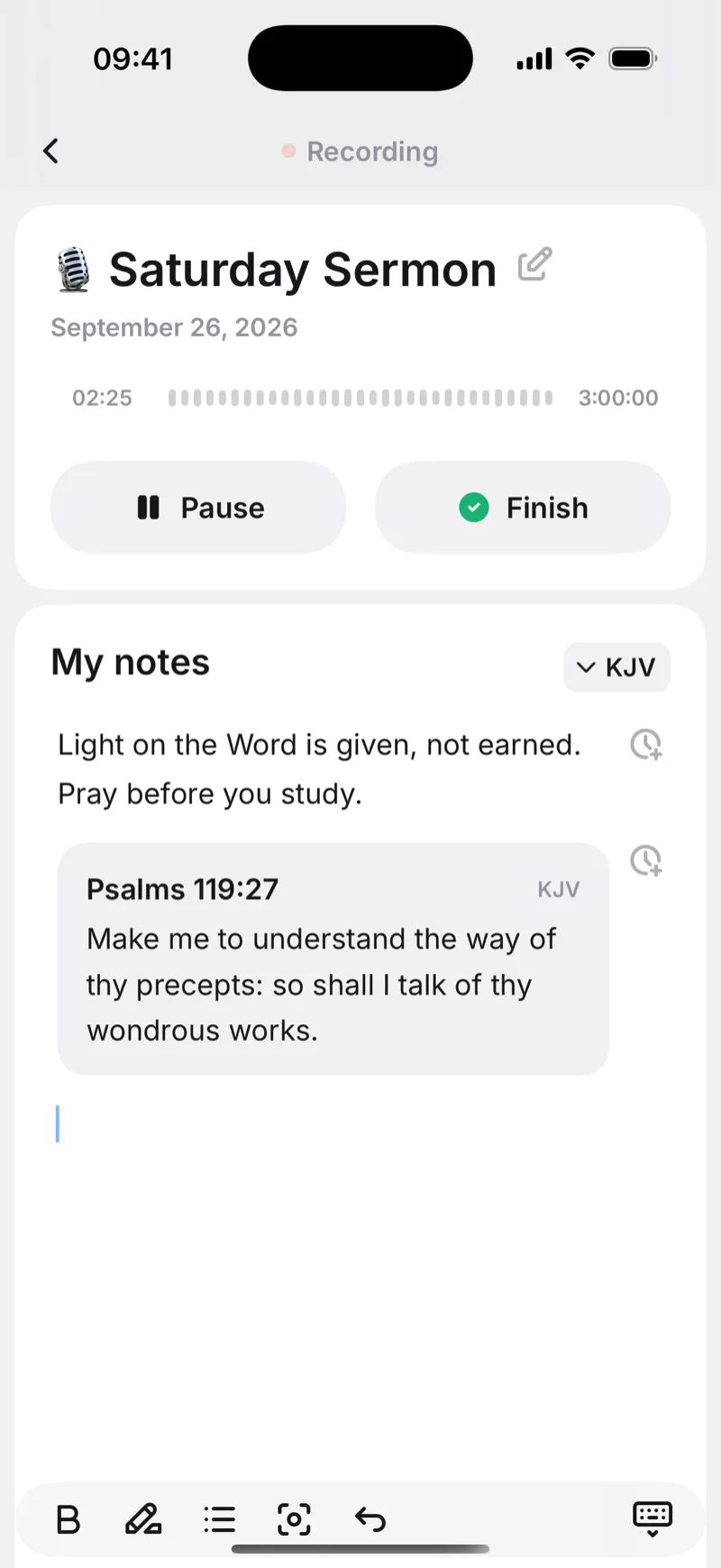
If you take notes on your phone, you can skip the hunting entirely. In Sermon Keeper, type a reference like "Romans 8:28" while the sermon records, and the full verse drops into your notes. Seven translations are built into the app and work without a signal, and if a verse is missing from the one you chose, the KJV text fills the gap, labelled as KJV.


How to say a reference out loud
When you read a reference aloud, in a small group or when you're leading, there are two common ways to say it. Both are right.
- John 3:16 — "John three sixteen," or "John chapter three, verse sixteen."
- 1 Corinthians 13:4–7 — "First Corinthians thirteen, four through seven."
- Psalm 23 — "Psalm twenty-three." Use "Psalm" for a single psalm and "Psalms" for the book as a whole.
Putting it together
A reference is always book, chapter, verse. A colon splits chapter from verse, a dash is a range, a comma is a list and a semicolon starts a new passage. A number in front of a book is part of its name, and a one-chapter book may give only the verse. Keep the abbreviation tables handy for the first few weeks and it becomes second nature.
When you're ready to go further, our guide on how to take notes in church covers what to write down once you've found the passage, and the SOAP Bible study method is a simple way to spend ten minutes with one verse during the week. If you'd rather your phone did the looking up, we compared the apps that detect Bible verses.
Frequently asked questions
It is an address: the book of John, chapter 3, verse 16. The name is the book, the number before the colon is the chapter, and the number after the colon is the verse.
It is part of the book's name. 1 Corinthians is Paul's first letter to the church in Corinth, read aloud as "First Corinthians." It is not a chapter number. Older Bibles write it with Roman numerals, as I Corinthians.
"ff" means "and the verses that follow." Romans 12:1ff points you to Romans 12:1 and the verses right after it, usually to the end of that section or chapter.
A dash is a range: John 3:16–18 means verses 16, 17 and 18. A comma lists separate verses: John 3:16, 18 means verses 16 and 18, skipping 17. A semicolon starts a new passage: John 3:16; 5:24 is two passages.
Chapter and verse numbers were added centuries after the text was written, and traditions number some passages differently. Hebrew Bibles often count a psalm's title as verse 1, and English Jonah 1:17 is Jonah 2:1 in Hebrew Bibles and in the Spanish Reina-Valera 1909. A few verses, such as Acts 8:37, also appear only in some translations.
Learn the order of the books in groups, use the table of contents without embarrassment, and remember that big numbers are chapters and small numbers are verses. If you take notes on your phone, an app like Sermon Keeper fills in the full verse as soon as you type the reference.