

Bible versions differ in two ways: how closely they follow the original Hebrew, Aramaic and Greek wording, and which ancient manuscripts they translate from. Word-for-word versions like the NASB, ESV and KJV keep close to the original sentence; thought-for-thought versions like the NIV and NLT put the meaning into natural modern English. None of them is a different Bible. They are different ways of bringing the same text into English.
If you've ever sat in church reading along while the pastor's words didn't quite match the page in front of you, this is why. This guide explains where the differences come from, puts the same verses side by side so you can see them, and helps you choose a translation you'll actually read.
Why there are so many Bible versions
The Bible wasn't written in English. The Old Testament is mostly Hebrew, with some Aramaic, and the New Testament is Greek. Every English Bible is a translation, and translators have to make three kinds of decisions.
- How literal to be. Hebrew and Greek don't build sentences the way English does. A translator can keep the original structure and ask the reader to work a little, or rebuild the sentence so it reads naturally.
- Which manuscripts to follow. We don't have the original documents, but thousands of handwritten copies. Many of the oldest were found after the King James Version was made, and where the copies differ, translations sometimes choose differently.
- What English sounds like today. Language keeps moving. Words that were clear in 1611 can mean something else now, so every generation revises or starts fresh.
Put those together and you get dozens of faithful translations that still sound different from each other.
Word-for-word, thought-for-thought, paraphrase
The most useful way to understand the versions is as a spectrum.
- Word-for-word (formal equivalence): follows the original words and word order as closely as English allows. NASB, ESV, KJV and NKJV sit here. They are good for close study, and a little harder to read.
- Thought-for-thought (dynamic equivalence): translates the meaning of each phrase into natural English. The NIV sits close to the middle; the NLT goes further toward everyday language. They are easier to read in long stretches.
- Paraphrase: one writer retells the text in contemporary speech. The Message by Eugene Peterson is the best known. It can make a familiar passage feel new, but it is best read alongside a translation rather than instead of one.
The CSB describes its own approach as "optimal equivalence," which places it between the ESV and the NIV.
The same verses, side by side
Differences are easier to see than to describe. Here are the same verses in six English translations, exactly as they appear in each.
John 3:16
| Version | John 3:16 |
|---|---|
| KJV | For God so loved the world, that he gave his only begotten Son, that whosoever believeth in him should not perish, but have everlasting life. |
| NKJV | For God so loved the world that He gave His only begotten Son, that whoever believes in Him should not perish but have everlasting life. |
| NASB 1995 | For God so loved the world, that He gave His only begotten Son, that whoever believes in Him shall not perish, but have eternal life. |
| ESV | For God so loved the world, that he gave his only Son, that whoever believes in him should not perish but have eternal life. |
| NIV 1984 | For God so loved the world that he gave his one and only Son, that whoever believes in him shall not perish but have eternal life. |
| WEB | For God so loved the world, that he gave his only born Son, that whoever believes in him should not perish, but have eternal life. |
The meaning is the same in every row. What changes is one Greek word, monogenēs. Older translations render it "only begotten"; many modern ones read it as "only" or "one and only," meaning unique. You can also see the NKJV and NASB capitalising "He" and "Him" when they refer to God, a choice the ESV and NIV don't make.
1 Corinthians 13:4
| Version | 1 Corinthians 13:4 |
|---|---|
| KJV | Charity suffereth long, and is kind; charity envieth not; charity vaunteth not itself, is not puffed up, |
| NKJV | Love suffers long and is kind; love does not envy; love does not parade itself, is not puffed up; |
| NASB 1995 | Love is patient, love is kind and is not jealous; love does not brag and is not arrogant, |
| ESV | Love is patient and kind; love does not envy or boast; it is not arrogant |
| NIV 1984 | Love is patient, love is kind. It does not envy, it does not boast, it is not proud. |
In 1611, "charity" meant self-giving love, from the Latin caritas. Today it mostly means donating to a cause, so every modern translation says "love." This is the clearest example of why the NKJV exists: same text, updated English.
Philippians 4:6
| Version | Philippians 4:6 |
|---|---|
| KJV | Be careful for nothing; but in every thing by prayer and supplication with thanksgiving let your requests be made known unto God. |
| NKJV | Be anxious for nothing, but in everything by prayer and supplication, with thanksgiving, let your requests be made known to God; |
| NIV 1984 | Do not be anxious about anything, but in everything, by prayer and petition, with thanksgiving, present your requests to God. |
"Be careful for nothing" sounds like advice to be reckless. In the KJV's English, "careful" meant "full of care," which is to say worried. The modern versions all say "anxious."
Psalm 23:1
| Version | Psalm 23:1 |
|---|---|
| KJV | The Lord is my shepherd; I shall not want. |
| ESV | The LORD is my shepherd; I shall not want. |
| NIV 1984 | The LORD is my shepherd, I shall not be in want. |
| WEB | The LORD is my shepherd; I shall lack nothing. |
"I shall not want" doesn't mean "I won't wish for things." It means "I won't lack anything," which the WEB spells out. And notice LORD in small capitals in most modern Bibles: it marks the place where the Hebrew has God's personal name, YHWH.
Bible translation comparison chart
Here are the versions you're most likely to meet in church, from most literal to most free.
| Version | Published | Approach | Reads like | Good for |
|---|---|---|---|---|
| NASB (New American Standard) | 1971; updated 1995 and 2020 | Word-for-word | Precise, sometimes stiff | Close study, word studies |
| KJV (King James Version) | 1611 | Word-for-word | Majestic, 17th-century English | Tradition, memorizing, reading aloud |
| NKJV (New King James) | 1982 | Word-for-word | KJV rhythm in modern English | KJV readers who want clearer language |
| ESV (English Standard Version) | 2001 | Word-for-word | Formal but readable | Study and everyday reading |
| WEB (World English Bible) | Around 2000, public domain | Word-for-word | Plain modern English | Free use and sharing |
| CSB (Christian Standard Bible) | 2017 | Between the two | Clear and natural | Reading and study |
| NIV (New International Version) | 1978; revised 1984 and 2011 | Thought-for-thought, near the middle | Smooth modern English | Beginners, daily reading |
| NLT (New Living Translation) | 1996 | Thought-for-thought | Conversational | New readers, long reading sessions |
| The Message | 2002 | Paraphrase | Everyday speech | A fresh angle on familiar passages |
One detail worth knowing: "NIV" today usually means the 2011 revision, while many older Bibles and apps carry the 1984 text, and the two differ in places. The NASB has the same split between 1995 and 2020. When you quote a verse, it helps to say which edition.
Why some verses are missing
Turn to Acts 8:37 in an ESV or an NIV and you'll find the number skipped, with a footnote. The King James prints the verse; the NASB 1995 keeps it in square brackets. The same happens with a handful of others, such as Matthew 17:21.
The reason is manuscripts. The KJV's New Testament, and the NKJV's, follow the Greek text printed in the 1500s, known as the Textus Receptus. Most modern translations follow older copies found since, and those copies don't include these verses. Translators didn't cut anything; they moved the words to a footnote so you can see what the later copies added. Our guide on how to read Bible references covers the other reason numbers can shift between Bibles.
Which Bible translation should you read?
The honest answer is the one you'll read. Beyond that, match the translation to how you'll use it.
- You're new to the Bible: start with the NLT or the NIV. They read like modern English, so you can follow a whole chapter without stopping.
- You want to study closely: the ESV or the NASB keeps the original sentence structure, which helps when a sermon or commentary leans on a single word.
- You grew up with the King James: the NKJV keeps the familiar phrasing and rhythm without the "thee" and "thou."
- You memorize Scripture: choose one translation and stay with it. Switching versions is the fastest way to muddle a verse you almost know. Our guide on how to memorize Scripture has nine methods that work.
- You want to follow the sermon: read what your church reads. It makes it far easier to keep your place while the pastor is speaking.
- You read in Spanish: the Reina-Valera family is the traditional Protestant choice; the 1960 revision is the most widely used today, and the older 1909 edition is in the public domain.
Many people end up with two: an easy-reading translation for daily reading and a more literal one for study. That's a good arrangement. Reading a difficult verse in two translations often clears it up faster than a commentary would.
A note on Catholic and Orthodox Bibles
Protestant Bibles have 66 books. Catholic Bibles have 73, adding books such as Tobit, Judith and 1 and 2 Maccabees, and Orthodox Bibles include a few more. Catholic readers in the United States will usually meet the New American Bible, the translation the readings at Mass are based on; its current edition is the NABRE. The translations in the chart above are Protestant editions.
Which translation is your pastor using?
Most churches tell you somewhere: the pew Bible, the corner of the screen where the verse is projected, the bulletin or the church website. If not, listen for clues.
- "Thee," "thou" and "-eth" endings mean the KJV.
- "Only begotten Son" in John 3:16 points to the KJV, the NKJV or the NASB; "one and only Son" to the NIV.
- "Charity" in 1 Corinthians 13 is the KJV; "love" is everything since.
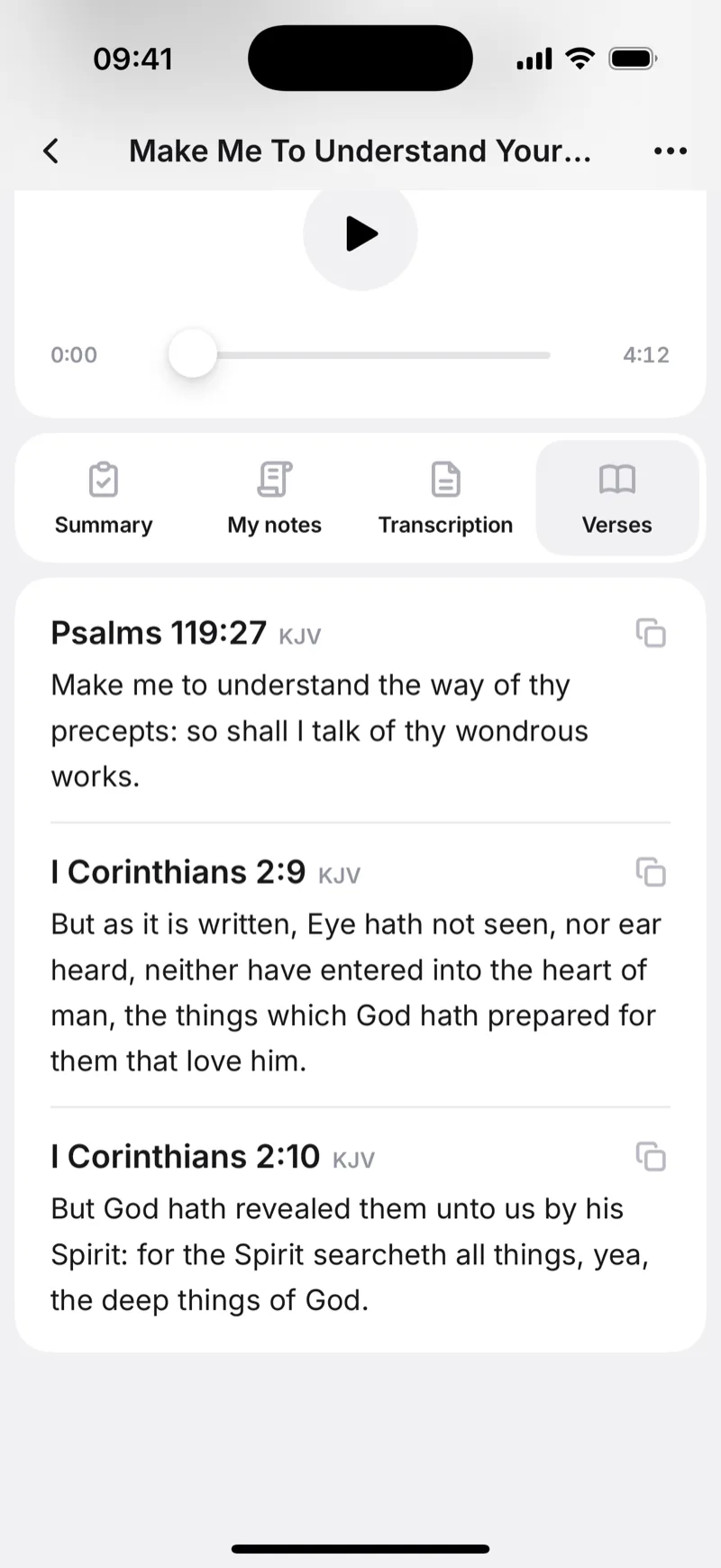
Sermon Keeper can do the comparing for you. It records the sermon, transcribes it and lists every verse the pastor mentioned. You choose your own translation from the seven built into the app (KJV, NASB 1995, ESV, NKJV, NIV 1984, WEB and Reina-Valera 1909, all offline), and that stays the default. For English sermons, the app also compares the transcript with how each of its Bibles words those verses. When the preacher clearly read a verse from another of them, it shows that verse in the translation you actually heard. When the evidence isn't clear, it keeps yours.


Putting it together
Every major translation is a serious attempt to bring the same Scripture into English. The differences come down to how literally each one translates, which manuscripts it follows, and how old its English is. Pick one that suits how you read, keep a second one nearby for hard passages, and read what your church reads on Sunday.
Once you have your Bible, try the SOAP Bible study method for ten minutes with one verse, or read our guide on how to take notes in church so the verses from Sunday stay with you through the week.
NASB 1995: Scripture quotations taken from the (NASB®) New American Standard Bible®, Copyright © 1960, 1971, 1977, 1995 by The Lockman Foundation. Used by permission. All rights reserved. www.Lockman.org
ESV: Scripture quotations are from the ESV® Bible (The Holy Bible, English Standard Version®), © 2001 by Crossway, a publishing ministry of Good News Publishers. Used by permission. All rights reserved.
NKJV: Scripture taken from the New King James Version®. Copyright © 1982 by Thomas Nelson. Used by permission. All rights reserved.
NIV 1984: Scripture quotations taken from the Holy Bible, New International Version®. Copyright © 1973, 1978, 1984 by Biblica, Inc. Used by permission. All rights reserved worldwide.
KJV: King James Version. Public domain. WEB: World English Bible. Public domain.
Frequently asked questions
They translate the same Hebrew, Aramaic and Greek texts with different goals. Some keep as close as possible to the original words (NASB, ESV, KJV, NKJV), some translate the meaning into natural modern English (NIV, NLT), and paraphrases like The Message retell the text in everyday speech. A few verses also differ because translations rely on different ancient manuscripts.
Most new readers do well with a thought-for-thought translation such as the NLT or the NIV, which read like ordinary modern English. The CSB is a good middle ground. If your church reads a particular version, starting there makes Sunday easier to follow.
"Accurate" can mean two things. If it means closest to the original wording, the NASB is usually named first, followed by the ESV, the NKJV and the KJV. If it means communicating the meaning clearly, a careful thought-for-thought translation like the NIV is also accurate, just in a different way. Both kinds are made by teams of scholars.
The NKJV (1982) keeps the King James Version's structure and underlying Greek text but replaces its 17th-century English: "thee" and "thou" become "you," "believeth" becomes "believes," and words whose meaning has changed are updated. "Charity suffereth long" in the KJV reads "Love suffers long" in the NKJV.
Modern translations such as the ESV and NIV are based on older Greek manuscripts discovered after 1611. A few verses the KJV prints, such as Acts 8:37 and Matthew 17:21, are not in those manuscripts, so these translations move them to a footnote and skip the number. Nothing has been hidden; the footnote tells you what was there.
Look at the pew Bible, the corner of the screen where verses are projected, or the church website. You can also listen for clues: "thee" and "thou" suggest the KJV, and "only begotten Son" in John 3:16 points to the KJV, the NKJV or the NASB. Sermon Keeper compares the recorded sermon with its seven built-in Bibles and, when the wording clearly matches, shows each verse in the translation the preacher read.