

To memorize Scripture, understand the verse first, learn it in short phrases, say it out loud, then test yourself by recalling it with the text covered, and review it on a schedule: daily for a week, every few days for a month, then monthly. The first-letter method, writing only the first letter of each word, is the quickest bridge from reading a verse to knowing it. Almost anyone can learn a verse in ten minutes. Keeping it is about review, not talent.
If you've tried before and found the verses gone a month later, that's not a memory problem. It's how memory works for everyone. This guide covers nine methods that match the way memory actually works, a simple review schedule, and twelve verses to start with.
Why memorize Scripture at all?
When Jesus was tempted in the wilderness, He answered each time from memory: "It is written, Man shall not live by bread alone, but by every word that proceedeth out of the mouth of God" (Matthew 4:4, KJV), quoting Deuteronomy. The psalmist gives the reason in one line:
Thy word have I hid in mine heart, that I might not sin against thee. Psalm 119:11 (KJV)
A verse you know by heart is there when you have no Bible or phone in hand: in a hospital waiting room, at 3 a.m., in the middle of an argument. It also changes how you listen on Sunday. When the pastor quotes a verse you know, you're following the thread rather than trying to catch up.
9 ways to memorize Bible verses
1. Understand it before you memorize it
Read the verses around it and ask what it meant to its first readers. Then say it in your own words. A verse you understand is far easier to remember than a string of words, because your memory has a meaning to hang them on. Philippians 4:13, for example, reads very differently once you notice that Paul is talking about being content with little or with plenty.
2. Pick one translation and stay with it
Memorizing John 3:16 in the NIV while hearing it in the KJV on Sunday is a recipe for a muddled verse. Choose the translation you read and hear most, and learn every verse in that one. If you're not sure which to choose, our guide to Bible versions compares them side by side. Many people find the KJV's rhythm easy to memorize, but any translation works if you stay consistent.
3. Break it into phrases
Most verses have natural pauses. Split at the commas and semicolons, learn the first phrase, then add the second and say both, then add the third. Proverbs 3:5 breaks cleanly into two:
- Trust in the Lord with all thine heart;
- and lean not unto thine own understanding.
For longer verses, this "build it up" approach keeps you from trying to swallow the whole thing at once.
4. Say it out loud
Reading aloud is more memorable than reading silently. Memory researchers call it the production effect: speaking engages more of you than seeing alone. Say the verse aloud in the car, on a walk, while you do the dishes. Muttering counts.
5. Use the first-letter method
Write down only the first letter of each word, keeping the punctuation. Psalm 119:11 becomes:
T w h I h i m h, t I m n s a t.
Now try to recite the verse from the letters alone. They give just enough of a hint to recall each word without letting you read it. Once you can do it smoothly, cover the letters too. Keep the letters on a card or in a note on your phone and use them for quick reviews.
6. Test yourself instead of rereading
Rereading a verse feels productive, but it mostly builds familiarity, not memory. Recalling it, with the text covered, is what makes it stick. Psychologists call this retrieval practice, and it's one of the most reliable findings in learning research. Cover the verse, try to say it, then check. The moments when you struggle and get it right are exactly when the memory strengthens.
7. Space out your reviews
Memory fades fastest right after you learn something, and more slowly each time you successfully recall it. So review often at first and then less and less. A simple schedule:
| When | How often |
|---|---|
| Day 1 | Learn it, and recite it three or four times during the day |
| Days 2–7 | Once a day |
| Weeks 2–4 | Every two or three days |
| Months 2–3 | Once a week, with your other verses |
| After that | Once a month |
If you forget a verse along the way, just move it back to daily for a few days. That's the system working, not failing.
8. Say the reference at the start and the end
"Psalm 46:1. God is our refuge and strength, a very present help in trouble. Psalm 46:1." Bookending the verse with its reference means you learn where it lives, not just what it says. It's what lets you find it again, share it, or look up the verses around it. If references still feel like code, our guide on how to read Bible references explains them.
9. Attach it to your day and use it
Tie your review to something you already do every day: brushing your teeth, the first coffee, the commute, the moment you get into bed. Then put the verse to work. Pray it back to God, text it to someone who needs it, or write it at the top of a SOAP study page. A verse you use is a verse you keep.
How to memorize a longer passage
The same methods scale to a psalm or a chapter. Learn it one verse at a time, and each day start from the first verse and recite through to the newest one. The early verses get reviewed every day without extra effort, and the passage builds up as a whole rather than as separate pieces. At one verse every day or two, most chapters take a month or two. Psalm 23, Romans 8 and the Sermon on the Mount (Matthew 5–7) are popular places to start.
12 verses to start with
If you don't know where to begin, these are short, widely loved and useful in real life. They're given here in the King James Version; learn them in whichever translation you use.
| Verse | Theme | Text (KJV) |
|---|---|---|
| Psalm 46:1 | Trouble | God is our refuge and strength, a very present help in trouble. |
| Proverbs 3:5–6 | Guidance | Trust in the Lord with all thine heart; and lean not unto thine own understanding. In all thy ways acknowledge him, and he shall direct thy paths. |
| Isaiah 41:10 | Fear | Fear thou not; for I am with thee: be not dismayed; for I am thy God: I will strengthen thee; yea, I will help thee; yea, I will uphold thee with the right hand of my righteousness. |
| Joshua 1:9 | Courage | Have not I commanded thee? Be strong and of a good courage; be not afraid, neither be thou dismayed: for the Lord thy God is with thee whithersoever thou goest. |
| Matthew 11:28 | Rest | Come unto me, all ye that labour and are heavy laden, and I will give you rest. |
| John 3:16 | The gospel | For God so loved the world, that he gave his only begotten Son, that whosoever believeth in him should not perish, but have everlasting life. |
| John 14:6 | Jesus | Jesus saith unto him, I am the way, the truth, and the life: no man cometh unto the Father, but by me. |
| Romans 8:28 | Hard times | And we know that all things work together for good to them that love God, to them who are the called according to his purpose. |
| Philippians 4:6 | Worry | Be careful for nothing; but in every thing by prayer and supplication with thanksgiving let your requests be made known unto God. |
| Philippians 4:13 | Strength | I can do all things through Christ which strengtheneth me. |
| 2 Timothy 3:16 | Scripture | All scripture is given by inspiration of God, and is profitable for doctrine, for reproof, for correction, for instruction in righteousness: |
| Psalm 119:11 | Temptation | Thy word have I hid in mine heart, that I might not sin against thee. |
One a week gets you through all twelve in three months, and with the review schedule above you'll still know the first one at the end.
Take your memory verse from Sunday's sermon
Here's a simple habit that ties memorizing to the rest of your week: each Sunday, choose one verse from the sermon as your memory verse. You've just heard it explained, so step one, understanding it, is already done. By the time you've learned it, you've spent the whole week with the sermon too.
Sermon Keeper makes that part easy. It records the sermon and lists every verse the pastor mentioned, shown in the translation you choose from the seven built into the app (KJV, NASB 1995, ESV, NKJV, NIV 1984, WEB and Reina-Valera 1909), all working offline. Copy the one you want with a tap and drop it wherever you keep your memory verses. Sermon Keeper isn't a flashcard app. It's a way to leave church with the right verse in hand, so choosing this week's verse takes seconds.
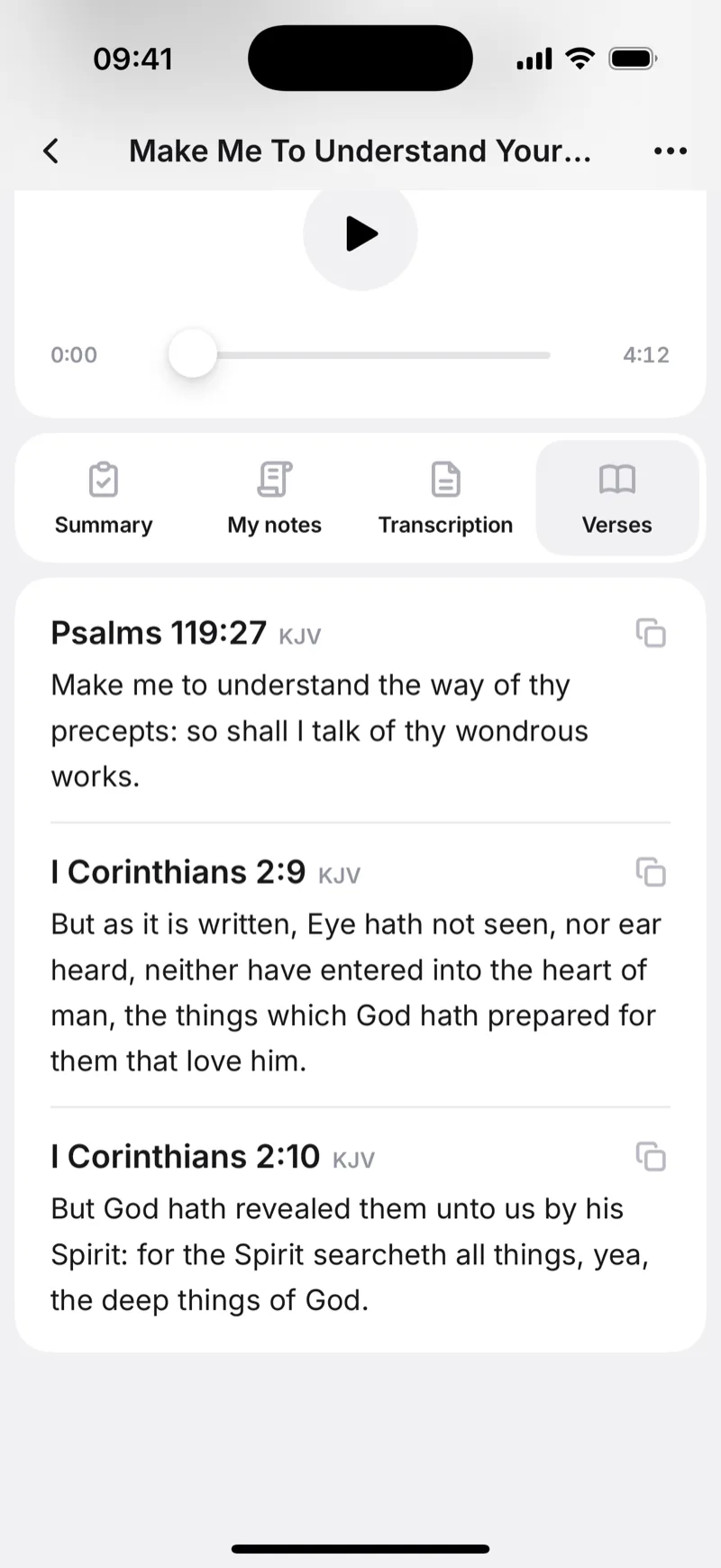


Putting it together
Memorizing Scripture isn't about having a good memory. Understand the verse, learn it in phrases, say it aloud, use the first letters, test yourself and review on a schedule. Start with one verse this week, and review it tomorrow before you add another.
For more on keeping hold of what you hear on Sunday, read how to remember sermons better, and to turn a verse into action, try our guide on how to apply a sermon.
Frequently asked questions
Understand the verse first, then break it into short phrases, say it out loud and test yourself by recalling it with the text covered. The first-letter method, writing only the first letter of each word, is one of the quickest ways to get from reading a verse to reciting it.
Most people can learn a short verse in five to fifteen minutes. Keeping it is the real work: review it daily for about a week, then every few days, then monthly. Verses you stop reviewing fade, which is normal and fixable.
The one you read and hear most often. The KJV has a strong rhythm that many people find easy to memorize, but the most important thing is to choose one translation and stay with it, so different wordings don't blur together.
Learn it one verse at a time, and each day recite from the first verse through the newest one. Adding a verse a day, or a verse every few days, gets you through most chapters in a month or two.
Usually because they're not reviewed. Memory fades quickly after you first learn something and much more slowly each time you successfully recall it. Keep a short review list and run through older verses once a week.
Keep verses short, add actions or a simple tune, and practice at the same moment each day, such as breakfast or bedtime. Children love reciting to someone, so let them teach the verse to a parent or sibling.